Wednesday, June 23, 2010

Alfred William Hunt - Mist Wreaths


[Mist Wreaths]
oil on canvas
exhibited 1861 at the RA ?
.
1830 - 1896
Liverpool landscape painter and watercolourist. Studied at Oxford where he won a prize as a poet. He was a Master there and married in 1861. Associate of the Liverpool Academy and exhibited at the RA and elsewhere. Influenced by the Pre-Raphaelites and his watercolours were praised by Ruskin. Painted in Scotland, Lake District and the Thames Valley but was particularly fond of North Wales and Whitby. Travelled in France.
His daughter, Violet Hunt, wrote a book on Rossetti.


http://en.wikipedia.org/wiki/Alfred_William_Hunt

http://www.artnet.com/artist/658175/alfred-william-hunt.html

John Samuel Raven - The Rooks' Parliament


[The Rooks' Parliament]
oil on canvas
exhibited at the Universal Exhibition, Paris in 1867
.
1829 - 1877.
Landscape painter, son of (Rev.) Thomas Raven (a watercolourist). Exhibited at the RA and elsewhere, iften views of Sussex, Wales and Scotland. Visited Switzerland and Italy. Self taught. Influenced by Crome, Constable and the Pre-Raphaelites. Lived in london from 1871 till his early death (drowning whilst bathing in Harlech). His younger sister married Henry Holiday another artist influenced by the Pre-Raphaelites. His brother-in-law records that Holman Hunt held this artist in high esteem.
.
It has been speculated that this was painted in or near Cobham in Kent. A label on the back calls it The Crops Green, the work shown at the Paris Exhibition. The artist seems to have changed the title later.


11 7/8 x 19 3/4"
http://www.artnet.com/artist/14010/john-samuel-raven.html

http://www.tate.org.uk/servlet/ArtistWorks?cgroupid=999999961&artistid=439&page=1

http://www.sothebys.com/app/live/lot/LotDetail.jsp?sale_number=L00727&live_lot_id=299
(though mine is from Christie's March 1992)

John Brett - Off the Coast, Guernsey


oil on board
7 x 14"
dated c. 1868

Benjamin Williams Leader - Moel Siabod, North Wales


signed and dated 'B. W. Leader/1859'
oil on canvas
35 3/4 x 30"

almost certainly inspired by John Brett's The Val d'Aosta, exhibited at the RA in 1859. This picture was painted the same Summer.

http://en.wikipedia.org/wiki/File:Brett-val-d-aosta.jpg

Albert Goodwin - The 'Betsy Jane', of Whitby, going to Sea


signed 'Albert Goodwin 1908'
24 x 26"

exhibited RA 1908

Albert Goodwin - The Ponte Vecchio, Florence


signed 'Albert Goodwin./80'
Watercolout and pen and black ink and pencil
11 1/4 x 17.5"

Tuesday, June 22, 2010

A Profound Secret: May Gaskell, her daughter Amy, and Edward Burne-Jones


http://www.amazon.co.uk/Profound-Secret-Gaskell-daughter-Burne-Jones/dp/0552999814


Fruit of a forbidden passion
http://www.telegraph.co.uk/culture/3615349/Fruit-of-a-forbidden-passion.html

http://entertainment.timesonline.co.uk/tol/arts_and_entertainment/books/article1041164.ece

Edward Burne-Jones - Portrait of Bessie Keene, Study for Vespertina Quies


oil on canvas
66 by 54cm., 26 by 21in.

Lot Sold. Hammer Price with Buyer's Premium: 37,250 GBP


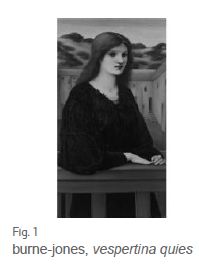
Vespertina Quies (FIG 1. Tate) which translates as 'Quiet of the Evening', was painted in 1893 and depicts a young girl dressed in a gown of deep, rich blue leaning on a balustrade with the empty courtyard of a convent and mysterious mist-veiled woodland beyond. The picture has been compared with the Mona Lisa, not only for the similarity of composition but also for the enigmatic expression of the woman. The enigmatic expression also recalls that of the mermaid in Burne-Jones' only Royal Academy exhibit The Depths of the Sea of 1887 (private collection) and of the various ghost-like women in The Sirens of c.1891-98 (John and Mabel Ringling Museum of Arts, Sarasota).

Vespertina Quies was originally owned by Mrs. Maurice Beddington and was
bequeathed to the Tate Gallery in 1940 by her daughter Maud. The Beddingtons had
been neighbours of Burne-Jones in Bennett's Hill, Birmingham and young Maud was
allowed to watch the artist as he worked on the painting. She recalled that 'He began by drawing the figure in raw umber... I think it was done before I came. Then he modelled the face in white and raw umber, lightly putting a little red on the lips, nostrils, and eyes.'(Martin Harrison and Bill Waters, Burne-Jones, 1973, p.158) It is the same technique that he used for this delicate study for the painting and for an oil sketch for Sibylla Delphica painted c.1885 (Cecil French Bequest, Hammersmith and Fulham Libraries).

The sitter for Vespertina Quies was Bessie Keene, a favourite model whose mother had
also posed for Burne-Jones. It was recalled by Graham Robertson that Burne-Jones
'used Bessie's face much in his later work - she succeeded her mother as chief 'angel' and 'nymph' - and he produced one beautiful portrait of her; actually a portrait, though he called the picture Vespertina Quies.' (William Graham Robertson, Time Was: The Reminiscences of W. Graham Robertson, 1931, p. 282) Vespertina Quies was perceived by the critic Frederic Stephens to be a pendant to Burne-Jones' portrait of his daughter Margaret entitled Flamma Vestalis of 1886 (Collection of Lord Lloyd Webber) both pictures depicting young girls dressed in black-blue. The fact that the young woman in Vespertina Quies was depicted playing nervously with a ring on her finger and with a convent courtyard behind implies that her emotions are conflicted and that she is deciding between marriage and celibacy. Similarly Flamma Vestalis depicts a melancholy vestal, caught in a world somewhere between Heaven and Earth but not entirely in either.

G F Watts - The Violinist, Blanche


signed with initials and dated l.l.: G. F. Watts 1875
oil on canvas
64 by 52cm., 25.5 by 20.5in.

Lot Sold. Hammer Price with Buyer's Premium: 85,250 GBP

Veronica Franklin Gould, G. F. Watts, The Last Victorian, 2004

Blanche Margaret Standish Clogstoun was born on 17 October 1862 and when she
was only nine-years-old she became Watts's ward. Her introduction to the artist has
been described by Veronica Franklin Gould thus; 'In a moment of spontaneous joy, a
sad little ray of sunlight pierced Watts's fatherly workaholic heart.' (Veronica Franklin Gould, G. F. Watts, The Last Victorian, 2004, p.109) The little orphan Blanche had been taken with her sisters Adeline and Mary to Little Holland House, dressed in mourning black, to meet their mother Mary's aunt 'Sara' (Sarah Prinsep, neƩ Monckton Pattle). The three children waited nervously in the doorway of the drawing-room, awaiting their introduction and hoping that they might be adopted by their wealthy relative. As Sara considered which of the girl's she might take as her ward, Blanche suddenly rushed across the room and leaped onto the lap of the surprised Watts who had been sitting reading by the fire. At this moment he decided to adopt the delightful little girl himself with Sara taking charge of her day-to-day care. The photographer Julia Margaret Cameron (Sara's sister) adopted the other two girls but unfortunately Adelina died when she was only ten. The responsibility of taking care of Blanche led Watts to write to his friend Charles Rickards; 'I have undertaken the charge of a little orphan girl so I must endeavour to do what I have not hitherto thought of doing, viz establishing a little capital.' (ibid Gould, p.109). It is likely that the portrait of Blanche dressed in a red and green dress and seated on an armchair (FIG 1. Sotheby's, New York, 25 April 2006, lot 114) was painted soon after her introduction to Watts.

Fearing that Little Holland House would not be exciting enough for a young girl,
Blanche was raised at the Prinseps' house at Freshwater on the Isle-of-Wight where
there was space and company for her to enjoy. The sadness of her early life was put
behind her and she grew to be a happy young lady with Watts and the Prinseps looking
after her.

This portrait of Blanche (or 'Daisy' as Watts called her) depicts her when she was
thirteen-years-old and it is unusual that he signed and dated it, suggesting perhaps that the picture was intended as a gift to his beloved daughter. The choice to depict her holding a violin suggests the improving education that Watts and Sara Prinsep gave Blanche. To encourage her to learn to play the fiddle, Watts took lessons himself and disagreed with his friend Rickards that it would be a corrupting influence on her life. He had known Joachim (whose portrait he painted in 1865), Madame Neruda and several other female violinists who had not fallen into a life of debauchery through their music and therefore he wrote to Rickards to tell him that he thought the warning was; 'constructively defective. If not let her wear no stays, run, jump, play at cricket with her brothers if she have any and otherwise exercise her limbs and lungs. I will answer for the violin being innocent of harm to her.' The broken strings of the instrument perhaps symbolise the broken relationships of her life; the loss of her mother and father and of her older sister.

In 1876, a year after painting Blanche, Watts painted another portrait of a girl holding a violin Blanche, Lady Lindsay (FIG 2. private collection) the wife of Sir Coutts Lindsay who was a friend of Lord and Lady Somers. Watts was attracted to the idea of depicting his sitters playing musical instruments, suggesting the contrast of visual beauty musical harmony. Notable examples include those of Alice Prinsep of 1860 and Prudence Penelope Cavendish Bentinck of c.1857. Music was important to Watts, perhaps even essential to his art. When Julia Margaret Cameron took a portrait
photograph of Watts in 1865, entitled Whisper of the Muse he was depicted playing a
violin to a pair of small girls.

When she was nineteen Blanche married Herbert Somers Cocks, the twenty year old
second cousin of Lord Somers. Somers Cocks was a Lieutenant in the Coldstream
Guards who had an exemplary military career and had fought in Egypt where Watts
noted he had been 'the youngest officer there' (ibid Gould, p.171). Blanche and
Herbert's wedding was held at the church of St. Mary Magdalene in Reigate, overseen
by Lady Henry Somerset and her mother Virginia Somers. The wedding reception was
at The Priory at Nutfield and their honeymoon was spent at Eastnor Castle. After the
wedding Watts wrote; 'Darling Daisy. I hoped when you married I should be able to give up feeling all anxiety about you, please let me think this may be.' (ibid Gould p.171)

Around this time Watts painted another portrait of Blanche as a handsome young wife
(FIG 3. Eastnor Castle Collection). In 1890 Watts gave Blanche, who was pregnant, his
house The Briary in which to raise her family; she had two children Arthur and Verena. She died in 1895, nine years before Watts.


William Bell Scott - Lady on a terrace with a baby; duel beyond


signed with initials l.r.: WB.S.
watercolour
12 by 20cm., 4¾ by 8in.