
Friday, July 2, 2010

William Morris - A Good Knight In Prison

A Good Knight In Prison
Wearily, drearily,
Half the day long,
Flap the great banners
High over the stone;
Strangely and eerily
Sounds the wind's song,
Bending the banner-poles.
While, all alone,
Watching the loophole's spark,
Lie I, with life all dark,
Feet tether'd, hands fetter'd
Fast to the stone,
The grim walls, square-letter'd
With prison'd men's groan.
Still strain the banner-poles
Through the wind's song,
Westward the banner rolls
Over my wrong.
William Morris
Thursday, July 1, 2010
Amateur sleuth discovers the site where Sir John Millais painted famous work of Ophelia

By Luke Salkeld
Daily Mail
------------------------------------------------------------------------------
It took an eye for detail almost as sharp as the artist's own.
But one amateur art sleuth believes she has found the exact spot where one of Britain's best-loved paintings was created.
Retired biology teacher Barbara Webb spent 18 months trying to find the real-life setting for Ophelia, Sir John Everett Millais's £30million masterpiece.
Using historic sources combined with local knowledge, Miss Webb, 80, has concluded that the Pre-Raphaelite artist set up his easel in Six Acre Meadow on the west bank of the Hogsmill River at the bottom of the Manor House garden in Old Malden, South West London.
John Byam Shaw - The Embrace

Signed with monogram; watercolour, 4¾ × 3½ ins
Rossetti was an early influence on Byam Shaw (as he is always known). He was an
extremely diverse and talented artist, muralist, stained glass designer, illustrator and tapestry designer. His most famous picture is probably The Boer War (1901;
Birmingham) although other masterpieces include Love the Conqueror (1899; private
collection) and The Queen of Hearts (1896; Pre-Raphaelite Inc.) Byam Shaw set up his
own art school with his friend Rex Vicat Cole that is still in existence in London today.
Frank Cadogan Cowper - Portrait of Fraunces Christie

Pencil, 11 × 8 ins
This is probably a portrait of Fraunces Christie, Cadogan Cowper painted Fraunces,
Beatrice, James and Synfye, Children of James Christie esq in 1919 (RA 1920 no.592).
The features of the sitter in the present study resemble the eldest girl in the portrait group. Cadogan Cowper is often referred to as ‘the last Pre-Raphaelite’ and like Ernest Board belonged to the group of painters known as the Neo-Pre-Raphaelites.
George Price Boyce - Edward Filliger, Study of a Boy, seated
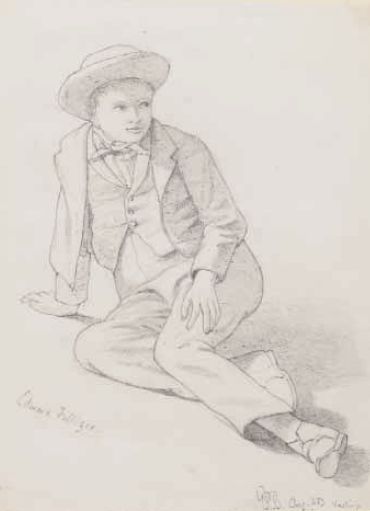
Signed with initials, inscribed ‘Edward Filliger, Hastings’ and dated Aug. ’50’; pencil, 7½ × 5½ ins
Provenance: Philip Street, the artist’s nephew, thence by descent.
Boyce lived in Chelsea and was a neighbour and friend of Rossetti, so he moved in
Pre-Raphaelite circles. Originally an architect, Boyce was encouraged to take up
watercolour by David Cox. He concentrated on landscapes and buildings mainly,
and his watercolours are now highly prized for their delicate Pre-Raphaelite colour
and detail. As these drawings reveal, he was also an accomplished draughtsman
Edward Burne-Jones - Study for the Court of Venus

Inscribed R; oil on canvas, 14 × 20½ ins
Burne-Jones painted this study in the mid 1860s. The subject is taken from the
Cupid and Psyche story in The Earthly Paradise. He never completed the painting
although a more finished red chalk drawing is in existence (private collection,
England). During the period 1864–1868 nearly all the paintings that he made were
from the designs for The Earthly Paradise
G F Watts - Portrait of a Lady, possibly Mrs Crawshay

Indistinctly inscribed with the sitter’s name and the artist’s address on a fragmented label
attached to the frame
Oil on canvas, 26 × 21 in, in the original Watts frame
Provenance: Lilian Mackintosh (the artist’s adoptive daughter) and thence by descent
This portrait is believed to be of the artist’s housekeeper Mrs Crawshay. Lilian
Mackintosh inherited the work from Watts. Lilian was educated at Roedean School
near Brighton and was permitted as a special favour to Watts to wear long flowing
Pre-Raphaelite dresses rather than the regular uniform. She was part of the Watt’s
household until the artist’s death in 1904. After the death of her husband Michael
Chapman, Lilian returned with her children to the Watts family home in Compton
where they remained until the 1930s.
Wednesday, June 30, 2010
G F Watts - Portrait of Lady Ashburton

Oil on panel; 15¾ × 11¾ ins
Lady Ashburton was a well-known hostess and collector, much admired by Thomas
Carlyle. She was also a friend of G.F. Watts, and bought from him two small versions
of Love and Death and Time, Death and Judgement.
G F Watts - Ellen Terry at the Piano

Inscribed: ‘Ellen Terry’
pencil
12 × 8¾ ins
Despite Ellen Terry’s blooming theatrical career, she willingly sacrificed the stage at the age of only 16 to marry G.F. Watts, who was 30 years her senior. Within a year
the marriage had failed. A later deed of separation cited “incompatibility of temper”.
This rather tender drawing by Watts shows the young Ellen at the piano. It was
formerly in the collection of Watts’s adopted daughter Lilian Chapman (née
Mackintosh); who inherited a number of the artist’s paintings and drawings.
Subscribe to:
Posts (Atom)