
Showing posts with label John William Inchbold. Show all posts
Showing posts with label John William Inchbold. Show all posts
Friday, December 28, 2012


Friday, December 7, 2012

Thursday, November 8, 2012

Tuesday, October 23, 2012
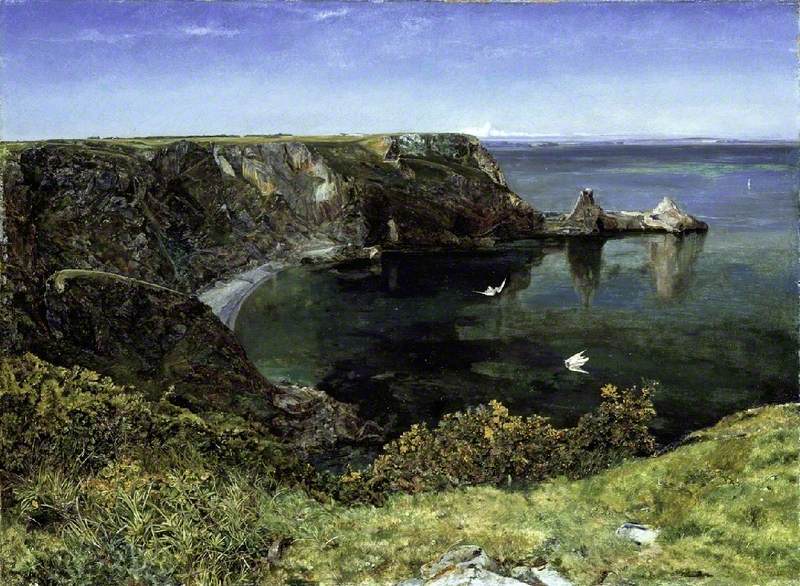
John William Inchbold - Gordale Scar, Yorkshire exhibited 1876

During the 1850s Inchbold was one of the most distinguished followers of the Pre-Raphaelites. His landscapes from this period show what one critic called 'an almost painful elaboration'.
Like so many other Pre-Raphaelites, Inchbold found it difficult to sustain this intensity of vision and technique. 'Gordale Scar', with its grand motif quite freely handled, characterises the change of direction which his art took in his later career. When it was first exhibited at the Royal Academy it was accompanied by lines from Wordsworth's sonnet 'Gordale' of 1818: '... when the air/Glimmers with fading light .../Then, pensive Votary!, let thy feet repair/To Gordale-chasm, terrific as the lair/where the young lions couch; ...'.

Thursday, October 11, 2012
John William Inchbold - Two Men Scything 1861

The image is painted in watercolour with detail in gouache applied over a pencil underdrawing on blue wove paper. It has suffered some discolouration and mount burn.
On acquisition the work was removed from its mount prior to being pressed, inlaid and mounted onto white museum board.
Shulla Jaques
Tuesday, January 3, 2012


Friday, September 2, 2011
John William Inchbold - The Common, June
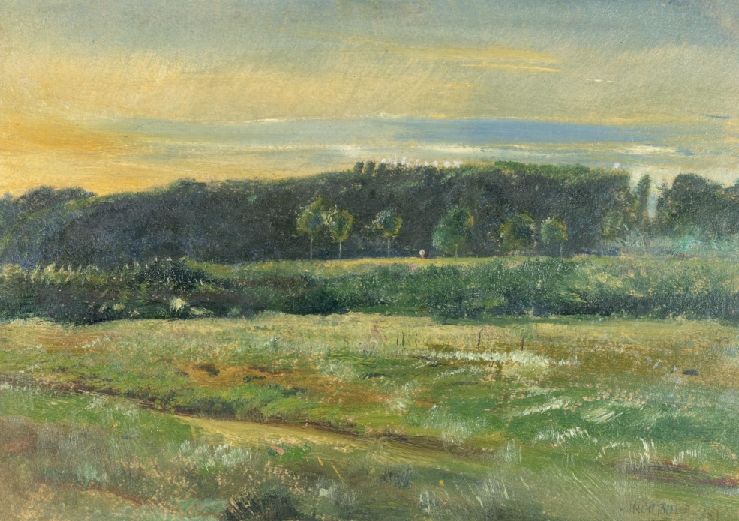
signed and dated l.r.: .INCHBOLD/ 1871.; indistinctly inscribed on the reverse: ___
Common, June
oil on card
17 by 24 cm., 6 1/2 by 9 1/2 in.
ESTIMATE 4,000-6,000 GBP
Lot Sold: 4,375 GBP
Sunday, July 17, 2011

Friday, July 15, 2011

Friday, January 14, 2011

Sunday, October 24, 2010

Thursday, September 16, 2010
John William Inchbold -The Cuillin Ridge, Skye

oil on canvas
51 x 69cm
This undated landscape has been identified as The Burn, November - The Cucullen Hills which Inchbold exhibited at the Royal Academy in 1856. As in A Study in March, the real subject, the burn of the title, is concentrated in the foreground. Also, as in the earlier picture, the landscape depicts the light and weather of a particular month, in this case, the chill, sharp light of a November day in North-West Scotland when the sun hardly rises above the horizon. Ruskin, who praised the 'exquisite painting of withered heather and rock' in The Cumin Ridge, commissioned four drawings from the artist and spent two weeks with him in Switzerland in 1858. 'It was' recalled Ruskin, 'a delicate and difficult matter to make him gradually find out his own faults ... and took me a fortnight of innuendoes. At last I think I succeeded in making him entirely uncomfortable and ashamed of himself and then left him.' It is not obvious that Inchbold was improved by this advice. It is more probable that the 'fortnight of innuendoes' and Ruskin's subsequent in
difference to his work profoundly discouraged Inchbold, who had an awkward and retiring character and who never fulfilled the promise of his early paintings.
Friday, July 16, 2010

Thursday, October 29, 2009
John William Inchbold - The Chapel, Bolton

1853
oil on canvas
Northampton Art Gallery
painted on the spot
20 x 27"
Thursday, February 19, 2009
John William Inchbold - In Early Spring

1855
oil on canvas
Ashmolean
A painting inspired by Wordsworth's poetry. This is believed to be a painting Inchbold exhibited at the RA in 1855 under the title A Study in March. It was accompanied by a line from Wordsworth, 'When the primrose flower peeped forth to give an earnest of the spring'.
Oil on canvas 53 x 35 cm Inscribed: JWI
Exhibited in 1855 with lines from the first book of Wordsworth's The Excursion:
'When the primrose flower
Peeped forth to give an earnest of the Spring.'
It has been pointed out that the concentration on the detail of the foreground distinguishes Pre-Raphaelite landscapes from the older, pastoral tradition in which the foreground is generally sacrificed to the middle distance. Despite the danger of spoiling the unity of the composition by working piece-meal on the details. lnchbold achieves an astonishing balance of detail and atmosphere, unified through the delicacy of touch and the natural luminosity of the colour, thinly laid onto a white ground in the manner of the Brotherhood. Ruskin. whose influence is evident throughout the composition. described the effect as 'exceedingly beautiful'.
Subscribe to:
Posts (Atom)